Most business leaders are familiar with Jim Collins’ flywheel effect, the idea that consistent effort across key activities builds unstoppable momentum over time. But in the real world, especially for operational leaders, the concept is great but doesn’t always translate to something that is directly actionable. What do you do when a project stalls, your pipeline dries up, or your cash flow tightens? Telling your team to “keep the flywheel spinning” doesn’t help you diagnose where the problem actually is. For me, I always felt that I could build multiple flywheels in the business, all which connected to each other.
To be fair, the use of Flywheels within Jim Collins teachings I feel is more of a strategic level tool, and I think Richard Koch did a good job in his book Simplify in explaining at another level the different types of strategic flywheels within businesses.
What I was looking for is something that linked more closely to the business, to the day-to-day actions and keeping the team focussed on what matters. Within the Scaling Up methodology, which we have been using for 10 years, we use the Process Accountability Chart (PACe) and the Function Accountability Chart (FACe) which are great, but they are still not creating an actionable system. The processes within our businesses are not something that is done once and static, its a constant and I think we need to be measuring it just as that, a constant push of the flywheel in each important area of our business creating greater overall flywheel momentum.
That’s where Cascading Flywheels come in.
This framework takes Collins’ original insight and makes it actionable by breaking your business down into a series of interdependent, function-specific flywheels; Marketing, Sales, Operations, HR, Finance, etc each with clearly defined steps, single-point accountability, and measurable KPIs. Every flywheel supports the next, creating a chain of momentum that drives the business forward. And when one falters, you know exactly where to look.
Why “Cascading”?
Because flywheels aren’t isolated. The output of one feeds directly into the next. A well-designed marketing campaign generates leads for Sales. Sales wins create estimating or delivery work. Delivery drives cash collection. If Marketing stalls, Sales starves, Estimating has no work, and your Cash flywheel grinds to a halt.
In a healthy business, these flywheels are aligned and spinning in sync across departments, down through teams, and out across geographies. But if any one wheel turns red, the entire system feels the drag.
What Makes the Flywheel System Work?
Here’s the heart of it:
- Each function is a flywheel, with 4–6 repeatable steps.
- Every step has a named owner and a specific KPI. If a step fails, you know whose fire to put out.
- Flywheels cascade. A complex step in one flywheel might have its own sub-flywheel below it. This scales the system across teams and locations.
- Meeting rhythms drive execution—daily for steps, weekly for tactical KPIs, quarterly for system reviews and strategic resets.
- Plug in expert tools. Don’t reinvent the wheel, bolt in frameworks from thought leaders you follow in Marketing or Branding to make it easier to build the flywheel
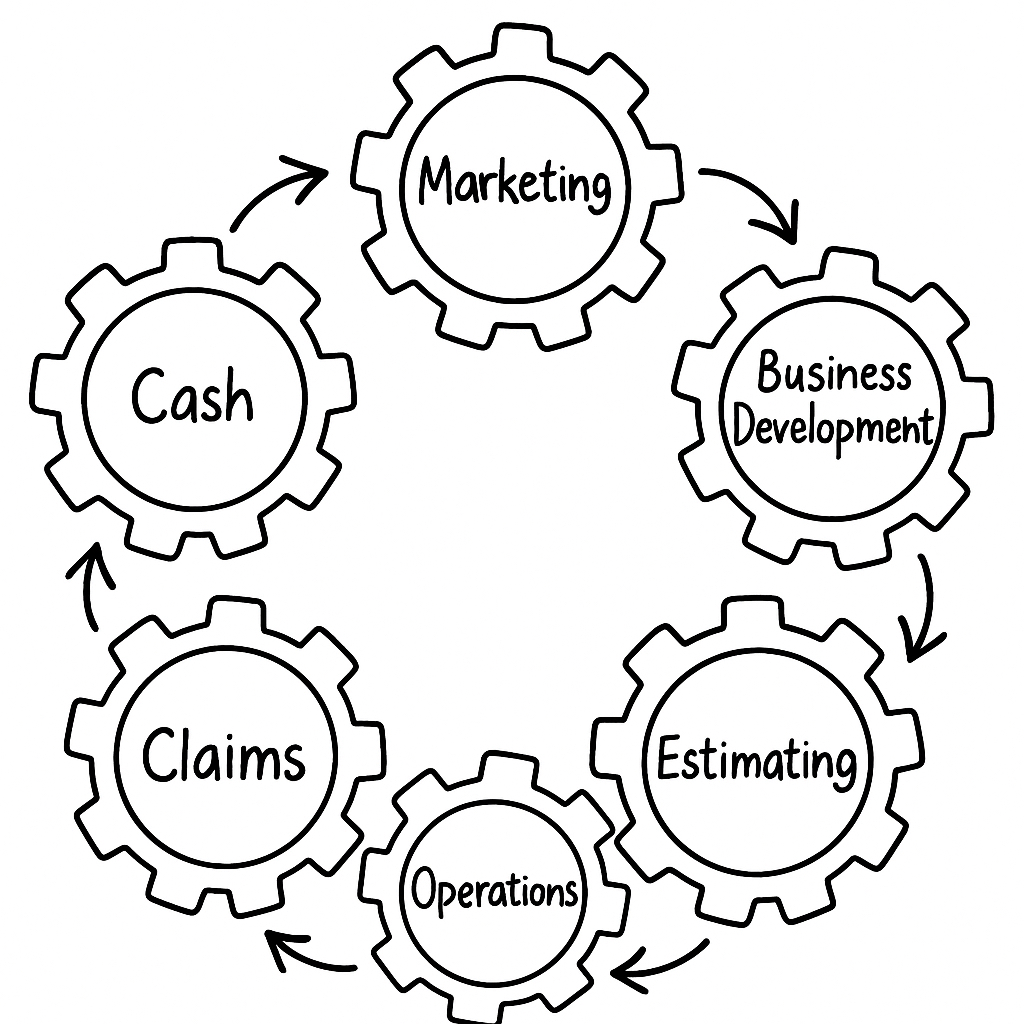
What This Looks Like in Practice
In my own business, TCD Group, we run six core flywheels: Marketing, Business Development, Estimating, Operations, Claims, and Cash. Every week, the team rates each flywheel green/yellow/red. If one is red, we dive into its steps. If “Submit Progress Claims” is red, and its owner’s KPI is off target, they know it needs to be fixed and if it requires a team effort, we jump in. It could be a focus, or it could be a new priority we put onto our quarterly plan. When that step goes green, Claims spins faster, Cash improves, and we can reinvest back at the start of the flywheel in Marketing, feeding the next cycle of the overall flywheel.
Why It Matters
- Clarity replaces confusion. Everyone knows their role in the momentum machine and we focus on the things that matter.
- Accountability is built-in, we understand what is important in the business and who is responsible for them.
- Execution becomes visible. If the wheel isn’t spinning, you know why.
- It scales. New teams or sites just build their own flywheels within the framework, this can go as deep as you want it to.
- You manage what matters—not tasks, but outcomes.
This isn’t just a metaphor, it’s a management system. Whether you’re running a construction firm, a tech startup, or a global team, cascading flywheels give you the structure to build real, compounding momentum step by step, owner by owner, meeting by meeting. I will dive further into Cascading Flywheels over time and how it is helping align our businesses, and maybe yours.
 Adam Taylor
Leave a comment